Most parents want to know how to handle a bored child the moment the words I’m bored leave their child’s mouth.
We understand the instinct. Your child looks unoccupied. You reach for a screen, a snack, a suggestion.
But there is a different way to think about this moment, and it changes everything about how children build focus.

The mother, the slime, and the half-day
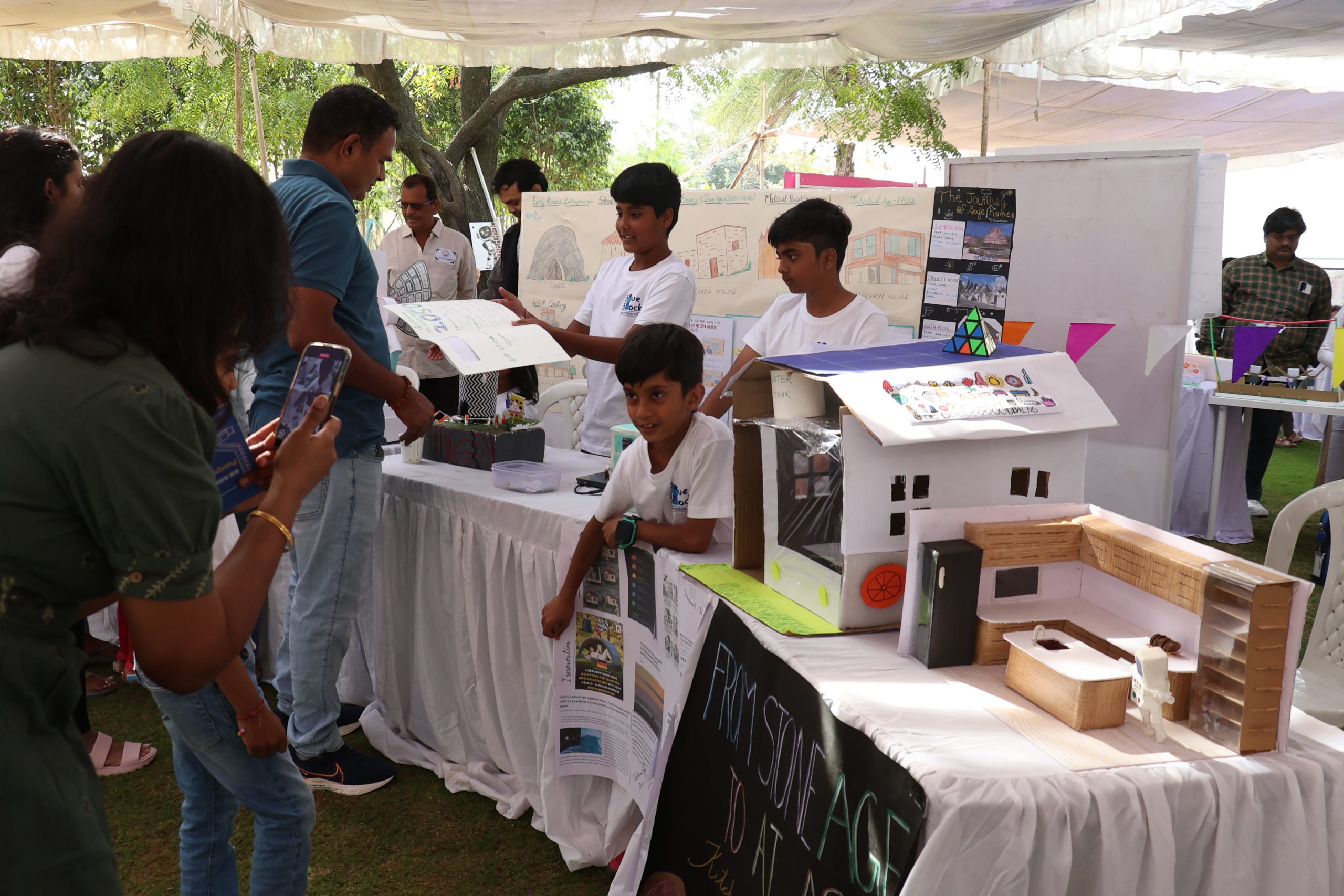
A mother we spoke to at our annual school event in November described an ordinary afternoon at home.
Her four-year-old son had been given some slime. No game built into it. No instruction. No other child to compete with.
He spent half a day with it.
He invented his own games. He made it thinner and thicker. He never said he was bored. He never asked for something else to do.
The four-year-old with the slime had spent half a day with himself. That, in our reading, is the more important thing he had built that afternoon. The slime was secondary.
Most parents would describe this as a child who entertained himself well. We think it is something more specific.
What boredom actually is in a child
Boredom in childhood is rarely the absence of something to do.
It is the gap between activities, the moment when external stimulation has stopped and the child has not yet generated her own next thing.
Every child has these gaps daily. What differs between children is what happens inside the gap.
The child who fills the gap for herself
A child who has been allowed to stay in the gap, repeatedly, will use it differently.
- She looks around
- She picks something up
- She starts to invent her own occupation
- A game with the slime, a story with the cushions, a question about the leaves outside
The gap becomes the doorway through which her own thinking enters.
She is not exempt from boredom. She has learned what to do with it.
The child who cannot tolerate the gap
A child who has been trained, year after year, to expect adults to fill the gap will grow uncomfortable in it quickly.
- She will report being bored
- She will ask for the next activity, the next show, the next snack, the next thing to look at
- The gap feels intolerable because she has never developed the muscle for filling it herself
Why how to handle a bored child matters more than parents realize
Sustained engagement with one’s own attention is the underlying capacity for almost all serious work in adult life.
Consider the people who do work that matters:
- The scientist holding a research question across years
- The writer keeping a draft alive across rewrites
- The engineer staying with a difficult problem until it yields
- The parent staying present with a difficult conversation
All of them rely on the same underlying disposition: the capacity to sit with what does not immediately resolve.
The capacity to stay engaged when nothing external is providing direction, this is not a personality trait. It is a developed skill, built in early childhood.
The window is narrower than most parents realize
This capacity is not built in adolescence. By adolescence, the disposition is largely set.
It is built in early childhood, in the small daily moments where the child either fills the gap herself or has it filled for her by adults.
This is why how to handle a bored child matters so much between ages 3 and 8.

How modern parenting undoes the capacity
Modern parenting tends to fill the gap. We do this from love.
We see a child looking unoccupied and we offer:
- A screen
- A snack
- A suggestion
- A game
- A redirect
The intention is generosity.
The effect, repeated thousands of times across early childhood, is that the child does not develop the capacity to occupy herself. She becomes dependent on external direction even when she has not asked for it.
Screens are the sharpest version of this pattern
A tablet with auto-play does not merely fill the gap, it teaches the child that gaps are meant to be filled instantly, by something outside herself, with maximum stimulation.
Every screen session trains the child in the wrong direction for building focus. The gap is closed before it opens.
How to build focus in young children: three practices
If you want to build the capacity rather than undo it, three small daily practices help. None of them requires a curriculum or a program.
1. Resist filling the gap
When your child has finished one activity and has not yet started another, do not immediately offer something.
Wait.
The first few minutes will feel uncomfortable. The child may say she is bored. Hold the silence.
The gap is not empty time, it is the space in which her own thinking has the chance to start.

2. Provide unstructured materials, not entertainment
Open-ended materials let the child invent her own use:
- Slime, sand, water
- Paper, blocks, fabric
- Stones, twigs, leaves
- Cardboard boxes, clay dough
Toys that do something when a button is pressed are entertainment. They occupy the child without requiring anything of her.
The slime moment we described above is what happens when the materials are open and the adult does not intervene.
3. Resist comparing one child’s pace to another’s
Some children fill the gap quickly. Others sit with it for longer.
The slow filler is not a problem child. She may be the one developing the deepest capacity for sustained attention.
Adults who interrupt her to check whether she is alright are filling her gap for her, exactly when she most needs to fill it herself.
What this looks like in a Montessori environment
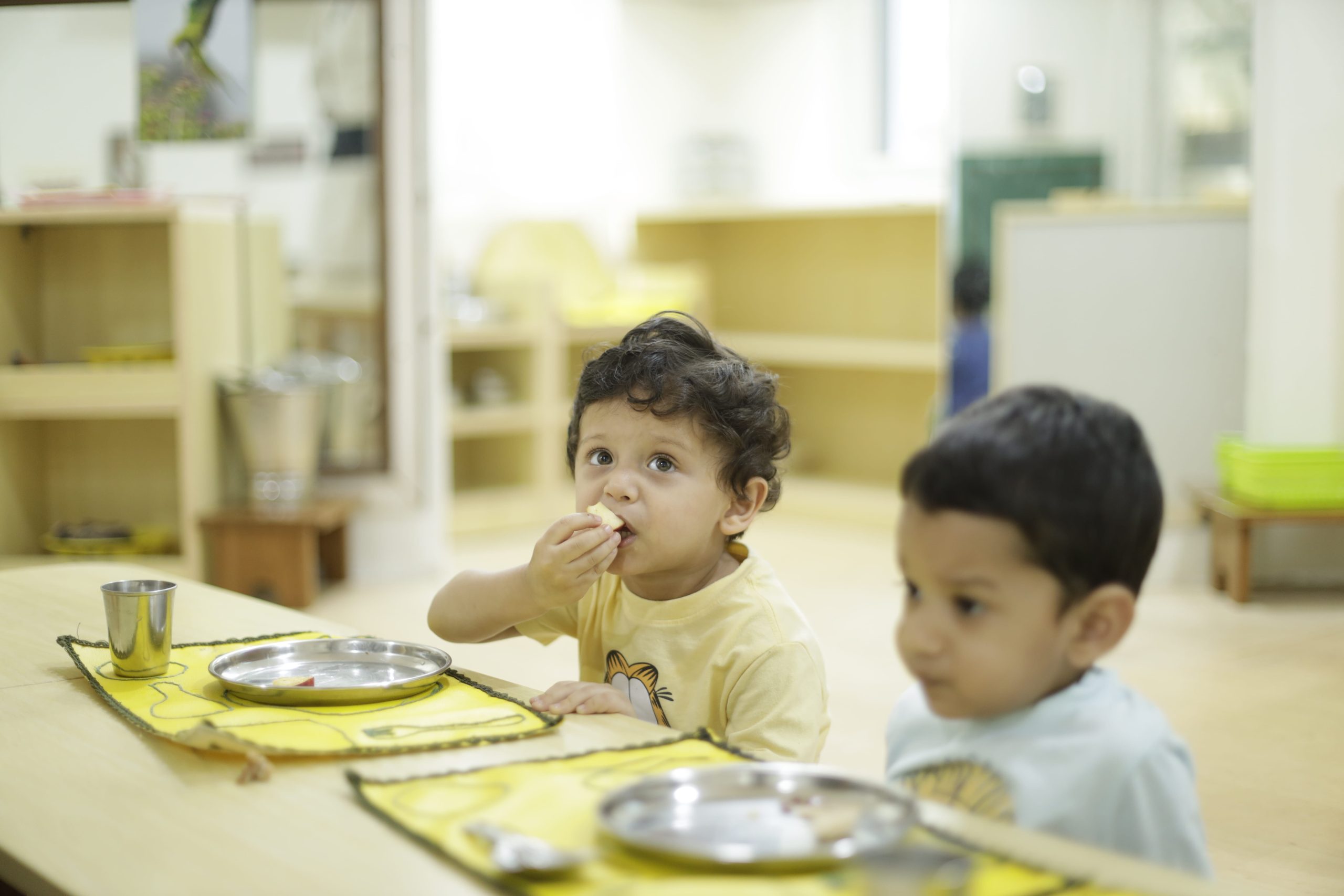
In a well-run AMI Montessori environment, the gap is structural.
Children choose their work. They return to it as often as they need. They complete it on their own timeline. Adults observe without interrupting.
The protected stretches of time in which a child stays with her own chosen work — sometimes finishing, sometimes setting it aside, sometimes returning to it the next morning — are exactly the conditions in which the capacity for sustained self-engagement is built.
We have written separately about how curiosity at age three becomes a project at age thirteen through the same underlying process, and about how the same disposition prepares children for the unpredictable world of 2050.
Maria Montessori built this into her method more than a century ago. We have spent seventeen years protecting it in our environment.
Because we have watched, again and again, what it produces in children by the time they reach adolescence.

The bottom line for parents
The next time your child says I’m bored, remember what actually happens in the gap that follows.
The gap is not a problem you need to solve.
It is the space in which your child’s own thinking has the chance to begin.
The four-year-old with the slime spent half a day with himself. If your child can spend half an hour, then an hour, then longer with her own attention across the years of early childhood, she is building the underlying capacity for every serious thing she will ever do.
How to handle a bored child is not about handling the boredom.
It is about not filling the gap that boredom opens.
Authors:
- Pavan Goyal, Co-founder, Blue Blocks Montessori School; Founder and Principal Investigator, Blue Blocks Micro Research Institute. Holder of all four AMI Montessori diplomas (0–18) and Trustee of the Indian Montessori Foundation. ORCID: 0009-0009-8840-8505. LinkedIn.
- Munira Hussain, Co-founder and Director of Pedagogy, Blue Blocks Montessori School; Secondary Investigator, Blue Blocks Micro Research Institute. AMI Auxiliary Trainer and co-author of Lining the Nest. Three decades of Montessori practice. ORCID: 0009-0003-5904-6206. LinkedIn.