When children teach adults something the adult did not know before, most parents assume the child in front of them is unusually gifted. A born presenter. A rehearsed talker.
We think this reading gets the child wrong, and it gets the school wrong too.
The reversal that surprises parents at our events, when the child ends up teaching the adult, is not a personality trait the child arrived with. It is a specific outcome of how the child has been taught, sustained across years of daily practice inside a Montessori environment.
When children teach adults with real understanding, answering questions no one prepared them for, adjusting the explanation for whoever is standing in front of them, connecting the concept to something the adult actually knows, they are not performing. They are showing you the work.
That work is the building of real understanding. And it is what a properly run Montessori environment structurally produces.

The child who taught an adult about alloys
At our annual event in November, a boy at one of the stalls set out to teach a visiting parent about shape-memory alloys.
He handed her a small wire, the thickness of a paperclip. He asked her to fold it in her fingers into whatever shape she liked. She made a rough spiral. Then he asked her to drop it into a beaker of hot water on his table.
The wire uncurled and returned, all at once, to the straight length it had started as, as though it had remembered its own name.
The parent, who had walked through the event expecting to admire children’s projects, left that stall having genuinely learned something about a material property she had not encountered before.
“We come here to see what students have learned during the academic year, but when we go out, we feel like we have learned here,” parent, Explore Montessori 2025
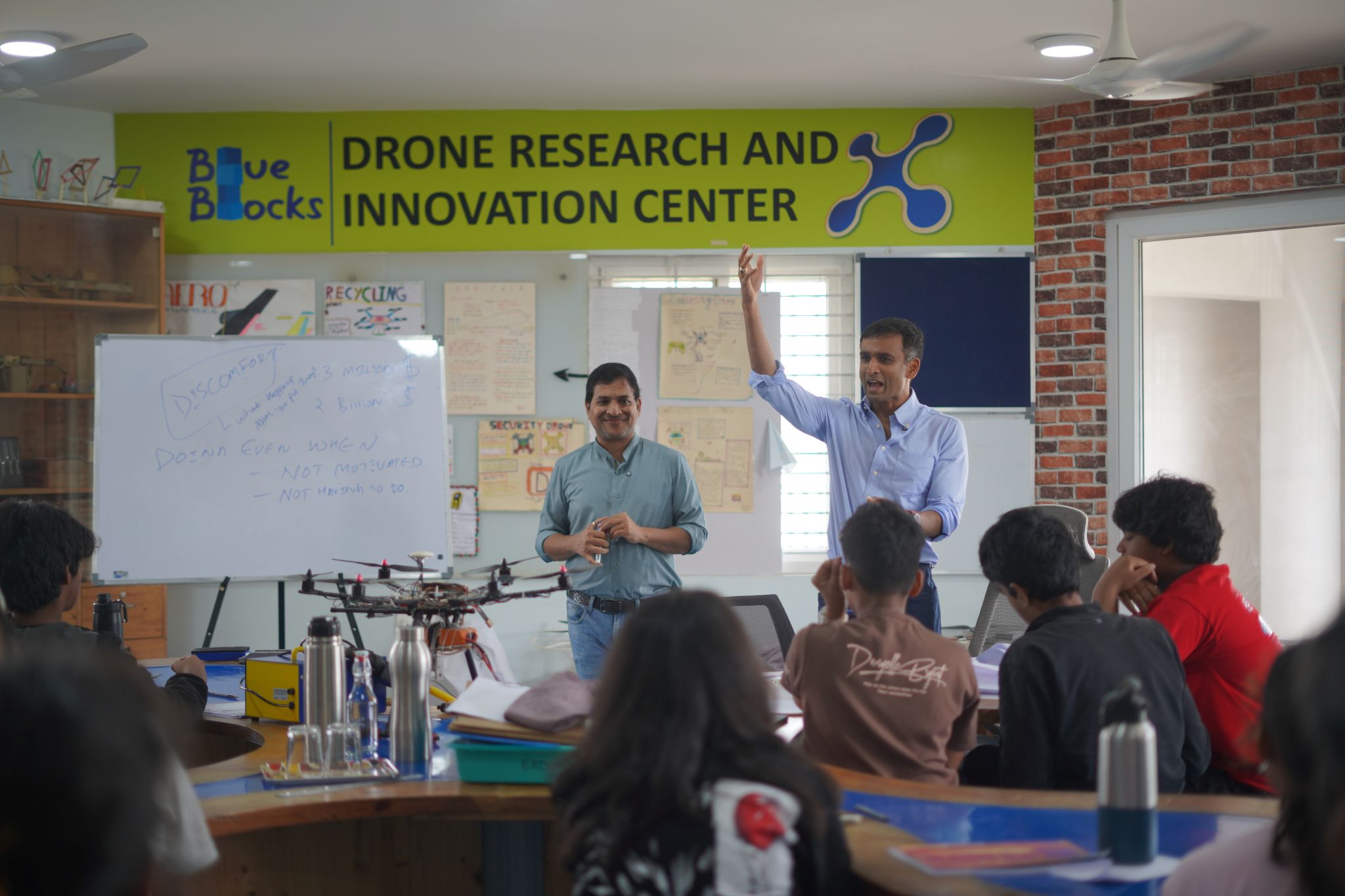
This reversal is the surprising part of what happens at our events. Not the confidence of the children, and not the inventiveness of the projects. The surprising thing is that the children teach the adults, and the teaching is real.

When children teach adults: what actually makes it possible
There are two ways a child can come to know a topic, and only one of them lets her teach it.
The first way is by memorizing. She takes in the words, holds them in order, and can give them back if you ask. This works for reciting, for tests, for the worksheet. But if you step slightly outside what she has been given, the knowledge falls away. She cannot answer a stranger’s question because the stranger has not been given the same script. Her knowledge stops at the boundary of what she was told.
The second way is different. In this second way, the child has worked her way inward from the surface of the topic to whatever underlying logic runs through it, by observing, asking, taking things apart, putting them back, testing, being wrong, trying again. She has taken the long route.
Because she has taken it, she can talk about the topic the way you talk about a city you have walked through, not the way you talk about a bus route you have memorized.
She can explain the same idea three or four different ways depending on what the listener already knows. She can connect it to something in the listener’s own experience without being asked to. She can pause when she does not know something and say so honestly. Her knowledge stops at the boundary of the concept itself, not at the boundary of a script.

The boy with the wire belonged to the second kind
He was not reciting shape-memory alloys. He had worked out, over weeks, what the alloy actually was, why the hot water mattered, what changing the temperature actually did inside the metal. When the parent walked up, he could meet her where she stood, without needing her to be standing where he had prepared for.
That is what real understanding produces. And that kind of understanding is not something a teacher can hand a child directly. It is what shows up, later, in a child who has been given the conditions to build it.
How Montessori builds real understanding
The classical AMI method that Maria Montessori developed across her lifetime does not build understanding by increasing what the child is told. It builds understanding, patiently and without visible drama, by protecting what the child does.
Think of it like a garden. A conventional classroom is closer to a factory: things move down the line at set speeds, everyone assembles the same object, and the child’s job is to keep pace. A Montessori environment is closer to soil. The child chooses what to grow, and how deep to send the roots, and how long to stay with one plant before moving on. The adult tends the conditions. The adult does not do the growing.
The four conditions that matter
Four conditions, sustained daily, produce the outcome:
- The child chooses what to study. Interest is the entry point into real concentration; you cannot smuggle it in from outside.
- The child stays with the work for as long as it holds her. Depth needs time that is not chopped by a bell.
- The child returns to the material without an adult scheduling the return. Consolidation happens quietly, across weeks, not inside a single period.
- The child is not tested through recall. She is observed while she works.
These four are not enrichment features layered on top of a curriculum. They are structural, present from the first day of the child’s admission. The child who explains shape-memory alloys at fourteen has been living inside these four conditions since she was three. What she showed the parent that afternoon at the stall was the accumulation of eleven years of that slow, protected practice.
Real understanding is not built by increasing what the child is told. It is built by protecting what the child does.
What our research shows
None of this is our editorial opinion. It is a documented pattern the Blue Blocks Micro Research Institute has begun to publish evidence for.
A palaeontology program with adolescents
Our Dean of Research, Sreemoyee Chakraborty, ran a four-session palaeontology program with twelve adolescents in April 2026, using genuine research material: real thin sections, real fossil specimens, real scientific keys, no simplification. Three of the twelve took the work up as their own and continued past the formal sessions, producing observations that Sreemoyee could later carry into conversation with her own academic collaborators without needing to translate for them.
The full case study is published on our research site: When Children Enter Deep Time (DOI: 10.5281/zenodo.20019376).
A student satellite mission
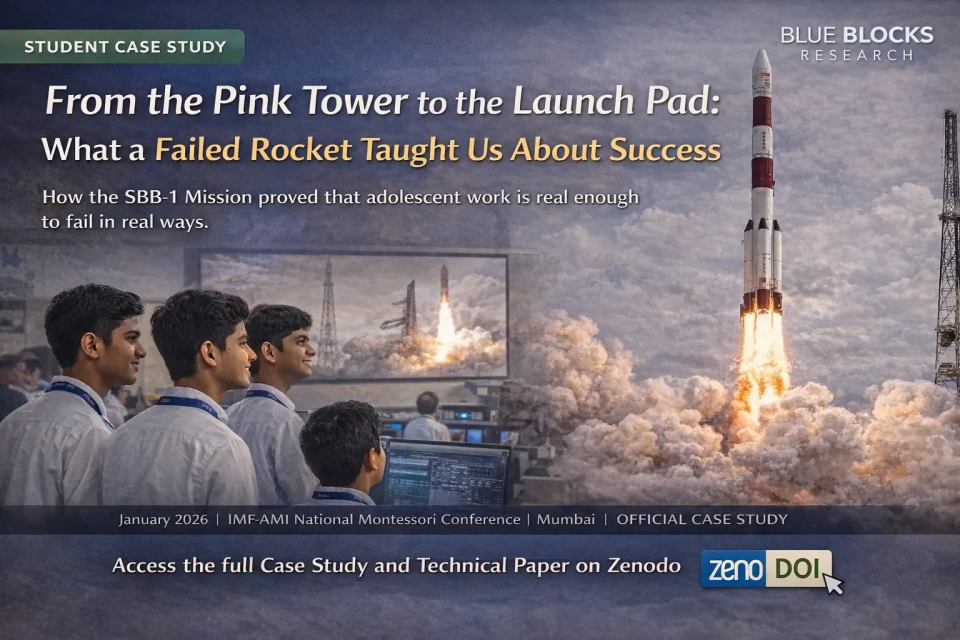
Seventeen adolescents from our Erdkinder program presented the SBB-1 satellite mission at the Indian Montessori Foundation’s Saparya conference in early 2026. This included the mission’s launch anomaly and the students’ response to losing the satellite. The presentation was not scripted. The students took questions from experienced AMI trainers and international attendees, most of them unanticipated. They answered the questions in their own words, from what they knew, not from what they had prepared.
The full case study is published on our research site: Valorization in Orbit (DOI: 10.5281/zenodo.18337934).
The methodology behind the outcomes
The framework that lets us observe and document these outcomes across our AMI-guided environment is set out in Blue Blocks Micro Research Methodology (DOI: 10.5281/zenodo.18584816), published by the Blue Blocks Micro Research Institute.
What parents can watch for
If you are visiting a Montessori school event, or any school event that claims to build genuine understanding, there are three small tests that tell you a great deal about whether what you are seeing is real or rehearsed.
1. Ask a question the child could not have prepared for
Not a clarifying question about the display. A question one small step to the side of what the child has clearly been ready for. A memorized child will feel this and hurry back to the rehearsed material, the way a driver on a memorized route will refuse a detour. A child who has understood will pause, think for a beat, and try an answer.
2. Ask the same child to explain the same project a different way
Try something like, Could you explain that to my six-year-old? Or, Could you explain it without the diagram? A memorized explanation has one gear. A child who has understood has several, and can shift between them without effort, because she is not translating from a script but describing something she can see.
3. Notice whether you have learned anything
This is the most reliable sign, and it lives inside you rather than in the child. If you leave the event knowing things you did not know when you walked in, the school has built genuine understanding in its children. If you leave admiring polish but not any better informed, the event was a performance.
When children teach adults, the child is not the exceptional part of what you are watching.
The exceptional part is the school that did not train her to perform, and instead let her understand. Reverse teaching, the child in the position of teacher and the adult in the position of learner, is what happens when the four conditions have been protected across years: chosen work, uninterrupted time, unforced return, observation instead of testing.
Across seventeen years of running an AMI-guided Montessori environment, we have watched this outcome again and again. It is documented in our published research. It is visible in our children. And it is what a Montessori school event, done properly, actually shows you: not what the children have been told, but what they have understood, and, if you are willing, what they can teach you.
We have written separately about how the same disposition prepares children for the unpredictable world of 2050, and about why boredom in childhood is the doorway through which real understanding often enters.
Authors:
- Pavan Goyal, Co-founder, Blue Blocks Montessori School; Founder and Principal Investigator, Blue Blocks Micro Research Institute. Holder of all four AMI Montessori diplomas (0–18) and Trustee of the Indian Montessori Foundation. ORCID: 0009-0009-8840-8505. LinkedIn.
- Munira Hussain, Co-founder and Director of Pedagogy, Blue Blocks Montessori School; Secondary Investigator, Blue Blocks Micro Research Institute. AMI Auxiliary Trainer and co-author of Lining the Nest. Three decades of Montessori practice. ORCID: 0009-0003-5904-6206. LinkedIn.